iPhone 18 Pro Transparent Design: Apple's Bold Return to Translucent Aesthetics in 2026
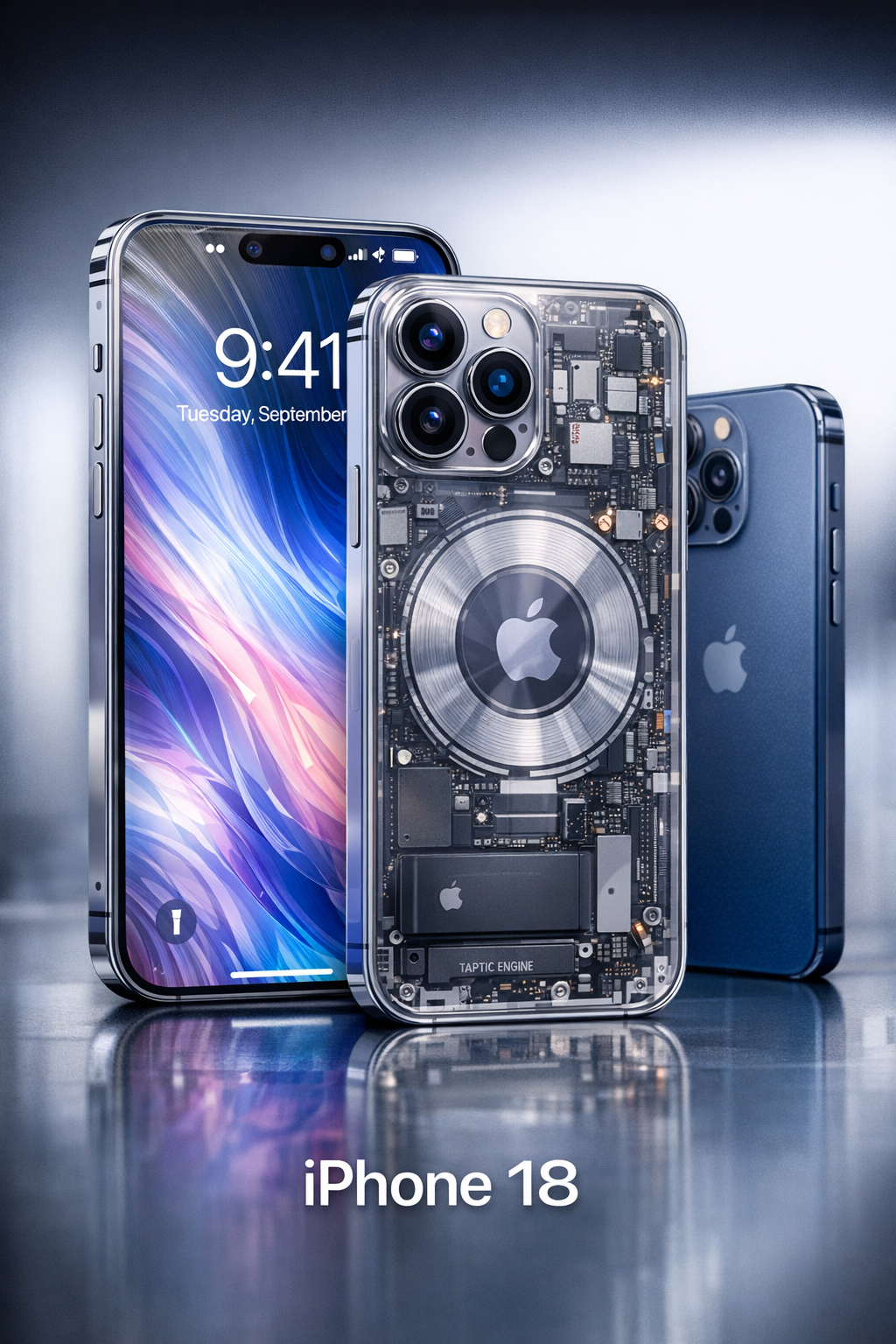
Apple's iPhone hasn't looked truly different in years. The rounded rectangle formula — glass back, camera plateau, aluminum frame — has been iteratively refined but never fundamentally reimagined since the iPhone X erased the home button in 2017. That changes in September 2026.
Mounting evidence from supply chain leaks, credible industry analysts, and Apple's own production validation testing confirms that the iPhone 18 Pro will introduce a partially transparent back panel, allowing owners to peer through the glass at the device's internal components. The MagSafe charging coil, circuit boards, and Taptic Engine will all be visible through a carefully engineered translucent window — transforming the back of the phone from a branding surface into an exhibition of engineering craft.
For designers, this is far more than a spec bump or a color refresh. It's a philosophical statement about the relationship between form and function — and it draws a direct line back to one of the most celebrated eras in Apple's design history.
The iPhone 18 Pro's transparent back panel isn't just a design gimmick. It represents a convergence of several design and engineering decisions — a 35% smaller Dynamic Island, the first-ever variable aperture camera in an iPhone, bold new Pro colorways including a deep burgundy red, and all of it powered by the A20 Pro chip on TSMC's 2nm process, the most advanced mobile processor ever fabricated. Together, these elements compose what may be the most comprehensive iPhone redesign since 2017.
The iMac G3 Connection: Why 1998 Matters in 2026
When Jony Ive unveiled the original iMac G3 in Bondi Blue, it wasn't just a product launch. It was a manifesto. The translucent polycarbonate shell declared that technology didn't have to hide behind beige plastic. Computers could be beautiful. Their innards could be beautiful. The fact that engineering was happening inside was something to celebrate, not conceal.
That philosophy — what Steve Jobs described as a "look at our beautiful technology" ethos — defined Apple's identity for years. The iBook followed with the same see-through aesthetic. The Power Mac G3 glowed with its internal architecture on display. Then, gradually, Apple moved toward sealed aluminum enclosures: elegant, yes, but opaque. The innards disappeared behind precision-machined walls.
Apple's Transparency Design Timeline
The iPhone 18 Pro's transparent panel reconnects Apple with that original design conviction: the idea that showing what's inside a device is an act of confidence. Only a company that believes its internal engineering is genuinely beautiful — the coil windings, the chip layout, the battery architecture — would dare to put it behind glass for the world to judge. With the iPhone's 20th anniversary arriving in 2027, this transparent design reads as a deliberate prologue: a statement piece that bridges Apple's most celebrated design era with whatever comes next.
Get the Weekly Signal
Every Tuesday: 6 trend signals reshaping design, jewelry, furniture, lighting, interiors & installations. Free forever.
Design Anatomy: What the Transparent Window Reveals
Based on supply chain intelligence and credible leaker reports, the transparent section is strategically placed around the MagSafe charging ring on the rear of the device. This isn't a fully clear-backed phone like early Nothing Phone experiments. Instead, Apple is using a precisely defined transparency zone — a controlled window that curates what the user sees.
The visible components reportedly include the wireless MagSafe charging coil (the large circular element), select integrated circuits, and the structural framework of the device's internals. Crucially, the battery and most of the logic board remain hidden behind opaque sections, preserving both aesthetic composition and structural integrity.
The difference between showing everything and showing the right things is what separates design from demolition. Apple's transparent window is curated — it's an exhibition, not a teardown.
This curatorial approach to transparency is key. Nothing Phone's Glyph Interface exposed LED strips behind a clear back — playful but decorative. Apple's approach uses transparency as a window into genuine engineering, making the functional internals the visual feature. The MagSafe coil, with its concentric copper windings, is inherently beautiful in the way a Swiss watch movement is beautiful. Apple recognized this and designed the transparency zone to frame it.
The Front: Dynamic Island Shrinks, Screen Expands
While the transparent back is the headline, the front of the iPhone 18 Pro is undergoing its own quiet revolution. Multiple credible reports confirm that Apple will significantly reduce the Dynamic Island cutout — the pill-shaped camera and sensor housing that has defined iPhone faces since the iPhone 14 Pro in 2022.
The reduction is achieved by relocating select Face ID components beneath the display. The infrared flood illuminator is moving under the screen, while the front-facing camera and remaining sensors stay in a much smaller central module. This isn't a transition to a simple hole-punch — Apple retains the characteristic pill shape — but the result is roughly 35% less screen real estate consumed by the cutout, yielding approximately 5% more usable display area.
From a design language perspective, this matters because the Dynamic Island has become visually synonymous with "iPhone." Shrinking it — without removing it entirely — shows Apple threading the needle between recognition and refinement. The company is preserving the design element that users associate with iOS interaction patterns, while reducing its visual dominance on the display. For UI designers, the expanded usable area opens new possibilities for immersive layouts and full-screen creative tools.
Variable Aperture: A Design-First Camera System
The iPhone 18 Pro's 48-megapixel main camera will introduce a mechanical variable aperture — the first in any iPhone. Dutch precision firm BE Semiconductor is reportedly supplying the aperture blade equipment. The system will allow the lens to physically adjust between roughly f/1.4 and f/2.0, changing how much light enters the sensor and how depth-of-field renders in images.
Why does this matter for design? Because it shifts the iPhone from a purely computational photography device to one that blends optical hardware with software processing. The physical aperture blades will create natural bokeh patterns — the smooth background blur that DSLR shooters have always preferred — rather than the algorithmically generated blur that phone cameras currently produce.
For designers, architects, and creatives who use their phone as their primary camera, this is a meaningful upgrade. Natural optical bokeh has different characteristics than computational bokeh: it follows the physics of light rather than an AI's approximation of it. The result is more organic, less processed-looking imagery — a quality that matters enormously in design documentation, mood boards, and visual research.
The front camera also receives a major upgrade: 24 megapixels, up from 18MP on the iPhone 17 Pro generation. Combined with Samsung's rumored three-layer stacked image sensor (PD-TR-Logic architecture) — which separates the photodiode, transistor, and logic layers for better noise handling and faster readout — the camera system becomes a genuinely professional-grade tool that sits in your pocket.
A20 Pro on TSMC 2nm: The Invisible Design Enabler
Powering the iPhone 18 Pro is the A20 Pro, the first mobile processor fabricated on TSMC's 2nm (N2) process node. Production validation testing was already underway in late February 2026, confirming that the chip is on track for mass production. While chipset specifications rarely make design headlines, the A20 Pro matters here because it's the enabling technology behind everything else: the real-time computational photography that supplements the variable aperture, the always-on display intelligence, and the machine learning models that power iOS 20's new contextual UI features.
For designers, the 2nm process also means better power efficiency — translating to thinner bezels, lighter devices, and longer battery life without increasing physical dimensions. Apple's ability to maintain the current form factor while adding a transparent panel, variable aperture camera system, and larger battery (rumored at 5,100–5,200 mAh for the Pro Max) is a direct consequence of the A20 Pro's thermal and power characteristics. The chip isn't visible through the transparent window, but its influence is visible in every design decision the phone embodies.
All iPhone 18 models will ship with 12GB of RAM, standardizing the memory architecture across the lineup. This is a quiet but important detail for app designers and developers: with a guaranteed baseline of 12GB, creative applications can be more ambitious with real-time rendering, multi-layer editing, and AR experiences without worrying about memory-constrained devices in the installed base.
Color as Design Strategy: Deep Red and the End of Neutral Dominance
Apple is reportedly testing a "deep red" finish — described as a rich burgundy — as the signature color for the iPhone 18 Pro lineup. If confirmed, this would be the first time such a vibrant hue has appeared on Apple's Pro-tier devices. The color palette also includes Coffee and Purple, continuing the bold direction established by previous Pro generations.
The shift away from safe neutrals (black, white, silver, space gray) toward expressive colors marks a strategic pivot. When every premium phone on the market defaults to subdued metallics, color becomes a differentiator. The transparent back panel combined with a deep red or coffee finish creates a layered visual effect — surface color blending with visible internals — that no competitor can replicate without the same underlying engineering confidence.
This is a deliberate design strategy, not a cosmetic afterthought. Deep red as the signature Pro color positions the iPhone 18 Pro as a design object first and a technology product second. It's the same logic that led Porsche to introduce its now-iconic Guards Red and Ferrari its Rosso Corsa — color as brand identity, not just finish option.
The Transparent Design Trend: Beyond Apple
Apple isn't operating in a vacuum. Nothing Phone pioneered transparent smartphone aesthetics with its distinctive Glyph Interface. Teenage Engineering has built an entire brand around exposed components and transparent housings. Even in automotive design, the trend toward revealing mechanical elements — exposed carbon fiber, visible suspension components in hypercars — reflects a broader cultural shift toward celebrating the functional beauty of engineered objects.
What makes Apple's entry significant is scale. Nothing sells hundreds of thousands of phones. Apple sells hundreds of millions. When the iPhone 18 Pro puts transparent design in the hands of that many consumers, it normalizes the aesthetic at a mass-market level. Expect to see the ripple effect across consumer electronics: transparent earbuds cases, see-through laptop sections, clear-backed tablets. Apple has historically set these kinds of cascading trends — the notch begat the notch era, the camera bump begat the camera island era — and transparent components are likely to follow the same trajectory.
The broader design philosophy at play — what might be called the "show your engineering" movement — extends beyond consumer tech. Architecture firms are increasingly exposing structural elements. Fashion brands showcase visible construction details. Furniture makers leave joinery on display. Apple's scale simply accelerates this pre-existing cultural current, giving it commercial validation at a level that smaller brands cannot.
Never Miss a Signal
Get weekly design trend analysis and industry intelligence straight to your inbox.
Production Reality: Where Things Stand in March 2026
The iPhone 18 Pro is no longer a rumor — it's a manufacturing reality. Apple has entered late-stage Production Validation Testing (PVT), the final phase before mass production ramps up. This testing phase is validating three new internal components: the A20 Pro processor on TSMC's 2nm process, the mechanical variable aperture camera system, and Apple's second-generation custom 5G modem.
The September 2026 launch will see only the premium models — iPhone 18 Pro, iPhone 18 Pro Max, and the new foldable iPhone (rumored as "iPhone Fold") — arrive first. The standard iPhone 18 and iPhone 18e will follow in spring 2027, marking a significant departure from Apple's traditional release cadence. This staggered approach ensures the transparent design and other Pro-exclusive innovations receive maximum spotlight during the critical holiday buying season.
Pricing is expected to hold steady, with the iPhone 18 Pro starting around $1,099 and the Pro Max at $1,199. Apple is reportedly managing this through aggressive component cost negotiations, particularly around memory chips with Samsung and SK Hynix — a signal that the company views the transparent design as a value-add that justifies premium positioning without requiring price increases.
Samsung's Three-Layer Sensor: A Quiet Supply Chain Revolution
One of the most consequential — and least discussed — changes in the iPhone 18 Pro is the potential shift from Sony to Samsung as the primary image sensor supplier. Samsung's three-layer stacked sensor architecture, known as PD-TR-Logic, separates the photodiode layer, transistor layer, and logic processing layer into distinct strata. This allows each layer to be independently optimized, resulting in better low-light performance, faster autofocus, and more efficient signal processing.
For photographers and visual designers, this translates to cleaner shadow detail, more accurate color reproduction in mixed lighting, and significantly reduced rolling shutter artifacts in video. The sensor is also physically more compact, which is part of what allows Apple to integrate the variable aperture mechanism without making the camera module substantially larger.
The supply chain implications are equally significant. Sony has been Apple's exclusive image sensor partner for the iPhone since the iPhone 6. A shift to Samsung sensors — even as a co-supplier — would reshape the competitive dynamics of the mobile imaging industry and potentially accelerate innovation as both companies compete for Apple's business.
What This Means for Designers
The iPhone 18 Pro's transparent design has implications that extend far beyond smartphones. For product designers, it validates a philosophy: that revealing internal complexity can be an aesthetic choice, not just a manufacturing shortcut. When the most valuable company on Earth decides to show its engineering, it gives permission for the entire industry to embrace transparency as a design language.
For digital and UI designers, the shrinking Dynamic Island and expanded display area will create new opportunities for immersive interfaces. Apps that push content to the very edge of the screen — video players, map applications, creative tools — will benefit from the additional real estate. The smaller cutout also simplifies layout decisions for developers who have had to design around the Dynamic Island's variable states.
For visual designers and photographers, the variable aperture camera system will produce meaningfully different output. Natural bokeh, better low-light performance without aggressive noise reduction, and more control over depth-of-field will make the iPhone 18 Pro a more capable tool for capturing design references, product photography, and visual research on the go. The upgrade to 24MP on the front camera also opens new possibilities for self-portrait-based design work and video content creation.
And for the broader design culture, the transparent iPhone validates what has been a fringe philosophy in product design: that showing how something works is itself a form of beauty. The Bauhaus principle of "form follows function" has been reinterpreted — in 2026, form reveals function. The internal components aren't hidden; they become the ornament.
The Design Verdict
The iPhone 18 Pro represents something rare: a genuine aesthetic risk from a company that has every incentive to play it safe. Apple could continue printing money with iterative refinements. Instead, it's reaching back to its design roots — the translucent, confident, "look at what we built" era of the late 1990s — and bringing that philosophy forward into the age of AI processors and satellite connectivity.
Whether the transparent design becomes a permanent fixture or a one-generation experiment will depend on consumer reception. But the signal it sends is unmistakable: Apple believes design has to keep evolving to capture attention. And in a market where every smartphone is a glass rectangle with a camera, that evolution might need to start by showing what's inside.
For designers watching this space, the iPhone 18 Pro is less a product to review and more a cultural barometer to study. It tells us where the world's most influential design organization thinks material culture is heading. And if Apple is right — if transparency is the next design language — then the ripple effects across architecture, fashion, automotive, furniture, and digital design will define the late 2020s as decisively as minimalism defined the 2010s.
Never miss a trend signal
Join design professionals who start every Tuesday with the top trends reshaping their industry. Expert-curated, free forever.

Design Signal articles are researched and drafted with AI assistance, then reviewed by the Design Signal editorial team before publication. How we work →